
kitchen remodeling
Rethinking Kitchen Design: Why the Kitchen Work Triangle May Be Past Its Prime
The kitchen work triangle is outdated. Modern homeowners are choosing style and functionality over traditional design rules. Expert insights on contemporary kitchen layouts.
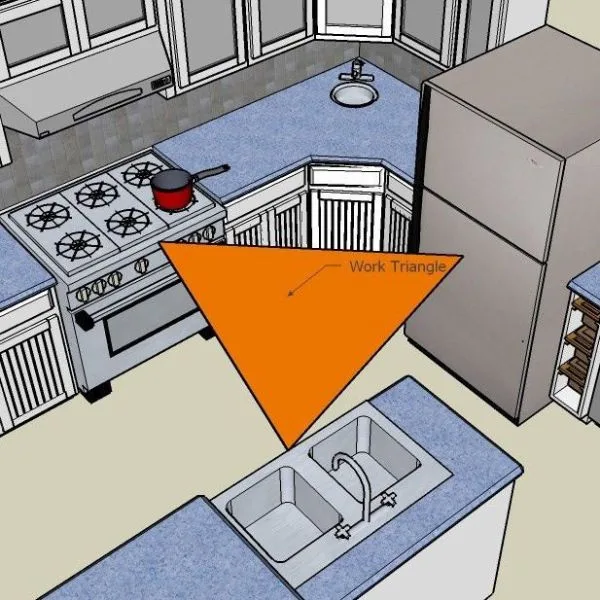
If you're planning a kitchen renovation, chances are someone has mentioned the legendary "work triangle" that time-honored design rule connecting your sink, cooktop, and fridge. After three decades in kitchen design, I've watched this principle get treated as sacred law. But I'm here with a reality check: for most modern homes, the work triangle has lost much of its relevance.
That's right I'm challenging conventional wisdom! While this concept still holds value in professional kitchens, today's residential spaces serve multiple purposes where visual appeal often outweighs pure functionality. Let's explore why 2025 homeowners are choosing style over strict adherence to traditional layouts, and why this shift makes perfect sense.
Understanding the Kitchen Work Triangle
Let's start with the basics. The kitchen work triangle emerged in the 1940s as a layout strategy positioning the sink, cooktop, and refrigerator in a triangular formation. Each leg of this triangle should ideally span 4-9 feet, creating an efficient pathway for food preparation. The concept aimed to minimize unnecessary movement, reduce congestion, and optimize cooking workflows particularly valuable in fast-paced commercial environments. However, residential kitchens serve vastly different purposes than restaurant spaces. They're where we enjoy morning coffee, host gatherings, supervise children's activities, and yes, occasionally prepare meals. Through my decades of design experience, I've observed that homeowners prioritize the emotional experience and visual impact of their kitchen over marginal efficiency gains.Why Modern Home Design Has Moved Beyond the Triangle
I'm not dismissing the work triangle entirely it remains a useful framework, particularly for compact spaces with limited square footage. But contemporary kitchen design has evolved significantly, and here's why the triangle often doesn't align with modern living:Kitchens Have Become Lifestyle Centers
Today's kitchens function as the central hub of family life. They accommodate dinner parties, remote work sessions, casual dining, and social media browsing for recipe inspiration. Homeowners gravitate toward open floor plans, expansive islands, and comfortable seating areas that emphasize community over clinical efficiency. A rigid triangular layout can feel constraining when creating spaces designed for multiple activities and users. I recently collaborated with a Rochester, Michigan family who transformed their narrow galley kitchen into an expansive open-concept design featuring a substantial island. While their refrigerator ended up slightly farther from the cooktop, the island became a versatile prep area, casual dining spot, and homework station. The family valued this multifunctional approach over strict adherence to the triangle principle.Aesthetic Appeal Drives Decision-Making
Here's the truth: most homeowners won't compromise stunning design elements for perfect workflow optimization. Contemporary kitchens showcase bold design choices – think striking quartz surfaces, vibrant cabinetry colors like rich Cinnamon Slate, and eye-catching backsplash patterns. When relocating a sink to capture beautiful window views disrupts the traditional triangle but creates an Instagram-worthy focal point, most clients enthusiastically embrace the trade-off. I've witnessed clients become completely enamored with deep emerald cabinetry or warm brass fixtures, happily adjusting their layouts to accommodate these statement pieces. One Shelby Township, Michigan client insisted on wraparound matchstick tile backsplash surrounding a corner sink placement, despite this positioning the cooktop outside the "optimal" triangle. The finished space resembled a work of art rather than a purely functional workspace.Contemporary Appliances and Layouts Challenge Traditional Rules
The work triangle concept assumes a single person moving between three designated points. Modern kitchens often incorporate multiple appliances dual ovens, beverage centers, warming drawers and accommodate several users simultaneously. Additionally, popular layouts like L-shaped configurations or linear designs don't naturally support perfect triangular arrangements. Smart technology in today's appliances, from connected refrigerators to precision induction cooktops, delivers efficiency through innovation rather than positioning alone. I designed a kitchen project in Harrison Township along Lake St. Clair where the homeowners incorporated a secondary prep sink within their island. This addition completely abandoned the traditional triangle concept, yet dramatically improved functionality for their frequent large-scale entertaining. Adaptability proved more valuable than rigid adherence to classic rules.Residential vs. Commercial Kitchen Priorities
The work triangle excels in commercial environments where speed and efficiency determine success. Professional chefs must produce numerous dishes rapidly, making every movement count toward productivity goals. Home kitchens operate under completely different parameters they're spaces for leisurely wine tastings, friendly conversations, and relaxed baking sessions with family. The overall atmosphere and experience matter more than optimized workflows. Modern residential kitchen design recognizes that cooking at home is often as much about the journey as the destination, emphasizing comfort, beauty, and social connection over pure efficiency metrics.Source
"Why the 'Kitchen Triangle' Is Outdated and What to Do Instead" - Country Living The Outdated Kitchen Layout You Have To Stop Relying OnThinking about your own project?
Explore our kitchen remodeling services or talk with our team about your space.
Talk with HomeWorks